Governance today is defined by decisions made without full information, under time pressure, and with long-term and potentially existential consequences. Boards are expected to provide fiduciary oversight, manage risk, and guide strategy in environments ...
Governance today is defined by decisions made without full information, under time pressure, and with long-term and potentially existential consequences. Boards are expected to provide fiduciary oversight, manage risk, and guide strategy in environments where neither stability, predictability, nor even “time to respond” can be assumed.
In an era of AI, the dynamics between boards and executives may evolve in unprecedented and challenging ways. The challenge is not change itself, but how directors and trustees interpret signals, weigh tradeoffs, and exercise judgment when certainty is unavailable.
In a world—and future—in flux, responsible governance depends less on prediction or traditional change management and more on clarity, discipline, relationships, and trust.
LAYERS OF FLUX
Governance operates on three interconnected levels: how directors and trustees lead themselves, how they support the executive team, and how they steward the organization together.
Self-leadership shapes judgment, bias awareness, and tolerance for ambiguity. Leadership of, with, and alongside others influences how boards engage executives, surface dissent, and build trust across stakeholder relationships. Organizational leadership determines strategic posture, risk appetite, long-term strategy, and resilience.
When boards are uncomfortable with uncertainty, effective governance breaks down. When boards lean into uncertainty and have developed the skills to harness it well, decision-making becomes calmer, more deliberate, and more effective.
Getting these dynamics right has never been more important than today.
Governance In Flux
- Fiduciary, risk, and strategic oversight are growing more complex as uncertainty accelerates.
- Boards face information overload, blind spots, and compressed decision timelines.
- Misalignment between boards, executives, and stakeholders can increase risk and weaken trust.
- Traditional governance and change management tools often overlook the human dimension of change and uncertainty: mindset, culture, language, trust, and tolerance of the unknown.
- AI can exacerbate all of the above
April’s Approach
- Reframes uncertainty as a core governance reality and series of dynamics, rather than a failure of planning.
- Applies a human-centered lens to fiduciary, risk, and strategic oversight
- Helps boards reduce noise, surface blind spots, improve decision quality, and develop a shared, practical language for uncertainty.
- Draws on her legal training (Harvard Law School) and global experience (100+ countries) to strengthen stewardship and trust.
- Brings joy, positive energy, and fresh perspective to everything she does.
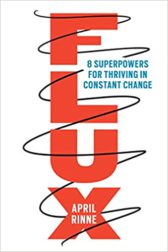
In her keynotes, presentations, and book FLUX: 8 Superpowers for Thriving in Constant Change, April guides the way.
She has been weaving a story about how to thrive amid flux for as long as she can remember, drawing on her history as a futurist, advisor, global development executive, microfinance lawyer, investor, mental health advocate, certified yoga teacher, globetrotter, and fun-filled handstander.
April also harnesses her very personal experiences with flux, including the death of both of her parents in a car accident when she was 20.
April brings a global perspective and taps into her deep first-hand personal experience to help leaders, teams, and organizations better see, think about, talk about, struggle with, grow through, and ultimately forge positive relationships with change.
April customizes her talks for each audience’s unique needs and goals. While the descriptions here are her favorites (and most popular), she’s also happy to tweak them upon request.