Curt Steinhorst

The Attention Guy who ran People at a Rocket Company

Curt Steinhorst wrote Can I Have Your Attention? (Wiley bestseller), then left the speaking circuit to run the people side of a rocket company. At Venus Aerospace, he helped build the teams behind the world’s most efficient rocket engine. The team designed, built, tested, and successfully flew the first high-thrust rotating detonation engine in under four years, on less than $80 million, making it the most capital-efficient rocket-engine program in history. Today, his keynotes cover leadership, attention, and doing hard things without being hard on each other. Because even when it’s rocket science, the hardest part is human.

  • Curt Steinhorst Keynote Speaker Fee Fee range is for U.S. events, depending on location and organization type

    $20,001 - $30,000

  • Languages Spoken

    English

  • Travels From

    Texas, USA

  • Curt Steinhorst Keynote Speaker Fee Fee range is for U.S. events, depending on location and organization type

    $20,001 - $30,000

  • Languages Spoken

    English

  • Travels From

    Texas, USA

Suggested Keynote Speaker Programs

Rethinking Leadership - It's not rocket science: A new model for leadership in the AI-driven workplace.

Our model of leadership has needed an overhaul for years. Leaders are expected to make good decisions without enough information, keep up with a flood of messages, be available whenever someone needs them, and somehow still have time to think. More and more of the job has ...

Our model of leadership has needed an overhaul for years. Leaders are expected to make good decisions without enough information, keep up with a flood of messages, be available whenever someone needs them, and somehow still have time to think. More and more of the job has become keeping up.

AI can help with that. It can make information easier to find and take some of the load off. But it cannot make a group work well together. The human work we’ve labeled “soft” cannot keep being left until everything else is done.

In May 2025, Venus Aerospace flew the world’s first high-thrust rotating detonation rocket engine. Whether it flew came down to the human side of the work: did everyone know their own job and let the others do theirs, could they argue without it getting personal, and did they like each other enough to laugh on a day when a mistake could cost a life?

In this keynote, Curt Steinhorst draws on fifteen years working with leaders from Nike to the U.S. Naval Academy and on his work as Head of People at Venus Aerospace to make the case for a leader’s job that gets easier as the tools get better: what comes off their plate, what stays, and how to build a team that will tell you the truth while there is still time to use it.

Where it fits: Association conferences, CEO and C-suite audiences, extended leadership team meetings, and emerging leader programs. On an AI agenda, it’s the one session that isn’t about the tools.

You’ll learn to:

– Identify work you can delegate or stop doing.
– Reassess what your team needs from your leadership as AI changes the work.
– Protect the attention your team needs for work that requires careful thought.
– Keep your team questioning assumptions under pressure.
– Work through disagreements without making them personal.
– Make it easier for your team to tell you when something is wrong.

Tags: Leadership, AI, Future of work, Teamwork, Change

Learn More

Rethinking Culture - It’s Not Rocket Science: Building a culture that does hard things without burning out

Somewhere along the way, culture went from eating strategy for breakfast to cupcakes for the anniversary/birthday/get well soon monthly party. That version of culture is a distraction from the thing that decides whether a culture is healthy: the work people are asked to do, ...

Somewhere along the way, culture went from eating strategy for breakfast to cupcakes for the anniversary/birthday/get well soon monthly party. That version of culture is a distraction from the thing that decides whether a culture is healthy: the work people are asked to do, and how they are asked to do it. And there’s no amount of perks or parties that can make up for someone who doesn’t know what gets them fired, what good looks like, what gets them promoted, and whether what they’re doing with the vast majority of their waking hours matters to anyone or any outcome. A company’s culture is how its people would answer those four questions, and almost no one ever asks them out loud. A merger or a growth spurt rewrites all four answers at once, and getting them clear again is where culture work starts.

At Venus Aerospace, the question was how to build a company capable of doing something extraordinarily difficult without burning people out. In the company’s language: How do we move at Mach 9 without burning out? In May 2025, Venus flew the world’s first high-thrust rotating detonation rocket engine. It reached flight in just over four years on roughly $80 million in capital, one of the fastest and most capital-efficient engine development efforts of its kind, according to Venus Aerospace.

Curt Steinhorst was Head of People at Venus, where he wrote the Venus Flight Plan (five values that guided how the company worked, who it hired, and what it tolerated) and implemented the plan across the organization. In this keynote, he draws on that experience and fifteen years working with leaders across industries to show how a leader’s decisions answer those four questions for employees, and how to make expectations clear and give people the authority to meet them.

Where it fits: HR, People, and culture events, and executive and association conferences where culture is on the agenda as strategy. All-company meetings before, during, and after a merger or a major strategy rollout, and the leadership offsites that plan them.

You’ll learn to:

– Identify where rewards contradict your stated expectations.
– Assess your culture through employees’ experience of doing the work.
– Clarify what good performance looks like as the organization changes.
– Match accountability with the authority to act.
– Make the connection between individual work and organizational results visible.

Tags: Culture, Employee experience, Accountability, Mergers & growth, Change

Learn More

Finding Focus in a Distracting World: Can I Have Your Attention? Focusing on what matters when everything is a priority, at work and beyond it.

AI can take routine work off a team’s plate. It can also make it easier to send more messages, launch more projects, and fill every hour it saves. The question is whether it gives people attention back for work that needs their judgment—or simply raises the volume of work ...

AI can take routine work off a team’s plate. It can also make it easier to send more messages, launch more projects, and fill every hour it saves. The question is whether it gives people attention back for work that needs their judgment—or simply raises the volume of work they are expected to keep up with.

Somewhere along the line, responding became the job and being reachable became proof you were doing it. A day cut into two-minute pieces by requests that have nothing to do with one another doesn’t add up to a day’s work, however many hours went into it. More often than not, the problem isn’t how much people have to do. It’s how divided their attention is, and because it got divided one reasonable choice at a time, that part a leader can change.

Drawing on over a decade of research and advising companies on attention and workplace dynamics, this keynote makes the case that distraction is confusion about what matters, and that the outcomes leaders are measured on, from productivity to how fast a team adapts to change to engagement and well-being, move when leaders protect attention on the team’s behalf. That takes a different way of approaching, measuring, and organizing work, one that respects the limit on human attention, because the same limit is what makes a person valuable once it’s pointed at the right thing.

For everyone in the room, it starts with deciding what deserves attention, recognizing what is pulling it away, and making room for the work and people they care about.

Where it fits: All-company meetings and conference general sessions, where every seat in the room can act on it.

You’ll learn to:

– Use AI to reduce routine work without filling the time it saves with more requests.
– Recognize how the demands on your attention shape the decisions you make.
– Decide what deserves your attention when everything has been called a priority.
– Make a team’s hours add up to a day’s work.
– Protect a team’s focus, starting with the meetings and messages they already control.
– Set boundaries that protect your attention for your best work and for a full life outside it.

Tags: Attention, Focus, Productivity, Engagement, AI

Learn More

Breaking Through the Noise: Can I Have Your Attention? Communicating so people hear it, believe it, and act on it

AI makes producing a message easier. Getting someone to pay attention, trust it, and act is still human work. Your ability to lead an organization or win a customer’s business depends on it. Information has exploded, publishing is free, and Graphite estimates that roughly ...

AI makes producing a message easier. Getting someone to pay attention, trust it, and act is still human work. Your ability to lead an organization or win a customer’s business depends on it. Information has exploded, publishing is free, and Graphite estimates that roughly half of newly published English-language articles are primarily AI-generated. What once captured attention now creates noise, and even what works today may not work tomorrow.

Why do people ignore information they need and pay attention to things they never intended to? The answer matters when you’re asking someone to reconsider a decision, support a change, or buy what you’re selling. Your audience brings different experiences, expectations, and reasons for listening. And increasingly, they’re accustomed to information selected specifically for them. How do you get them to consider an idea they weren’t looking for—and might not initially want to hear?

In this keynote, Curt Steinhorst, bestselling author of Can I Have Your Attention?, draws on the science of attention to show you how to shape and deliver messages that break through the noise.

This presentation is for anyone whose work depends on influencing others. It can be tailored to the communication challenges specific to executives, sales professionals, and communications leaders. You’ll get beyond this week’s LinkedIn algorithm tricks and into what makes people pay attention when the noise is so loud.

Where it fits: Sales kickoffs, marketing and communications teams, and any executive whose job depends on being heard.

You’ll learn to:

– Recognize how information overload and hyper-personalized media have changed audience expectations.
– Communicate across generations, cultures, and geographically dispersed teams.
– Apply the science behind what captures and keeps attention.
– Adapt your message for the medium and moment.
– Use advanced rhetorical techniques to make ideas more compelling and memorable.

Tags: Communication, Sales, Marketing, Presenting, Influence

Learn More

About Keynote Speaker Curt Steinhorst

Curt Steinhorst has spent his career closing the distance between people who have to work together but don’t speak the same language: across generations, between leaders and the people they depend on, and between what was said and what was heard.

He’s done it in Fortune 500 boardrooms, professional locker rooms, and inside the executive team of a hypersonic deep tech company.

Most recently, he spent three years as Head of People at Venus Aerospace, where he helped build the teams behind the world’s first flight of a high-thrust rotating detonation rocket engine, on roughly $80 million raised in the tightest venture market in decades. It turns out that even when it IS rocket science, the outcome still depends on people working together.

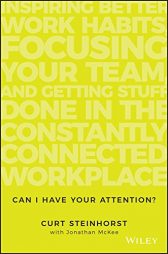
Before Venus, Curt built a company around the question of attention. He wrote Can I Have Your Attention? (Wiley bestseller) and became a Forbes contributor. He also has ADHD, which is either ironic or the whole point.

Curt got his start on the speaking circuit working with the Center for Generational Kinetics. He looked fourteen, so nobody was going to hire him to talk about anything other than millennials.

His current work centers on the questions AI can’t answer: what deserves our attention, how experienced leaders stay curious when industries shift, and how teams tell the truth under pressure.

Curt has delivered 500+ keynotes across four continents for clients including JPMorgan Chase, AT&T, Nike, Marriott, Accenture, Cisco, Deloitte, Southwest Airlines, KPMG, and the U.S. Naval Academy.

Off stage, Curt lives in Frisco, Texas, with his wife and kids and coaches youth basketball and baseball. He has gone his entire career without a cold plunge and has no plans for that to change.

Testimonials

“Curt’s ability to command the undivided attention of the room is second to none. For someone who claims that attention is the heart of communication, he really lives up to his message on stage.”
CEO, NTT DATA


“If you’re looking for someone who can equip your people to better focus in today’s work environment and do so while keeping them entertained and engaged, look no further than Curt. He made us think, he kept us laughing, and we left knowing how to improve our lives by reclaiming our attention.”

President/CEO of the Aspen Ski Company


“No workforce issue is more important to address than the challenge of digital distractions. Curt speaks to this issue with impressive knowledge and expertise, through a uniquely engaging and thought-provoking style. Read More

President, Training Industry Inc.


“I applied his specific focus strategies to block all the ‘noise’ out and focus. I found myself sharing with everyone in my office.”

Chapter President, HSMAI, DFW


“It’s no small feat to keep a room full of top performing wealth managers engaged and off their phones for an entire keynote. Not only did Curt maintain enthusiastic attention, but he gave us plenty of practical advice for Read More

Vice President

Ameriprise

“I had the opportunity to engage Curt to speak to all of our staff while we were in the middle of a merger. His presentation on thriving in the midst of uncertainty was timely and very well received by our people. Read More

Mark L.

CEO, Farm Credit West

“I was struck by Curt’s ability to think differently and immediately booked him.”

Scott B.

Founder & CEO, Big Machine Label Group

“The presentation was practical, funny, and well-received; we had a lot of buzz following the event. Curt’s message thoughtfully addresses a central challenge in our fast-paced work culture. He was a true delight to work with, and we are already planning to bring him back!”

Merck


Close

My Catalog

PDF

    This site is protected by reCAPTCHA and the Google Privacy Policy and Terms of Service apply.

    Submit Clear All

    You have not added any speakers yet.